
I submitted the below as an op-ed for the Sarasota Observer, in response to this article. They didn’t publish it. In it I emphasize the male role of protector, specifically in the mode of Aldo Leopold to see that we protect landscapes with the knowledge that “A thing is right when it tends to preserve the integrity, stability, and beauty of the biotic community. It is wrong when it tends otherwise.”
Much of modern psychotherapy deprioritizes having a sense of place while elevating a disembodied brain or mind or views interactions as being limited to those with other humans, isolated from the larger environment we live within. We lose the sense of right and wrong that Leopold identified, to our own detriment. And, because we feel less connected to it, we lose the sense that we are a part of nature, which incidentally degrades our ability to feel integrity, stability, and beauty within ourselves, with our own nature.
Developing a relationship with nature—through direct experience, reading environmental history, learning what is native to a place, and understanding the interconnections within landscapes—can help one cultivate the virtue of attentiveness. Defending what Leopold, in A Sand County Almanac (1949), called “the land ethic,” could help men reconnect with the crucial role of being a protector. “The land ethic,” he wrote, “simply enlarges the boundaries of the community to include soils, waters, plants, and animals, or collectively: the land.” Coming into deeper connection with the elements and within themselves and expanding the scope of what we are duty bound to protect to include soils, waters, plants, and animals can guide us to healing ourselves and the land in which we live.
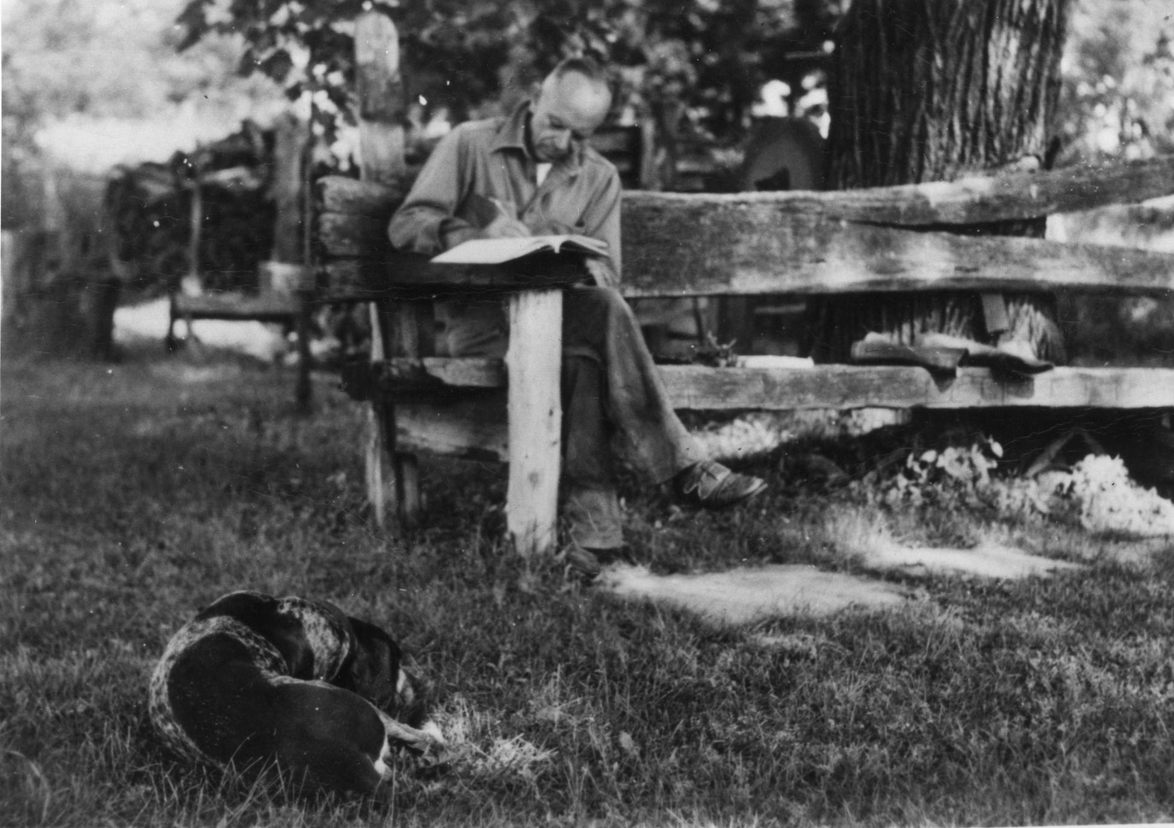
Aldo Leopold writing at the shack with dog Gus, 1939.
Flower Power
We have a plant problem in Sarasota. Men of great power and influence are being seduced by showy ones that come from far away. They melt before these exotic temptresses. Their strength and discernment wilt before the colorful petals you’ll see at a big-box garden center but not, when adequately funded and managed, a state park.
In a vacuum this wouldn’t be a bad thing. Seen apart from the living dynamic of local ecology, it might even be seen as a sign of progress or Wordsworthian romanticism for high-status men to get in touch with the more flamboyant displays of the plant world. But, despite technology’s and Humanities’ ever-expanding reality distortion fields, we live real lives in a real place. The boisterous blooms that have captured the tender hearts of these men, and the handshaking, back-slapping, and clapping that accompany their planting, hide a darker truth of destruction.
The problem, which you can sense if you want to as you approach the gated entryways of countless subdivisions, became clear to me when Observer editor Matt Walsh, in an even-handed July 2025 evaluation of New College of Florida president Richard Corcoran’s tenure, celebrated that “the entire campus is adorned with fresh landscaping.” Those last two words like nectar to those for whom Florida is essentially, as historian Gary Mormino called it, a state of dreams. Okay, but what is the landscaping? A drive by suggests a manicured overdose of ornamentals.
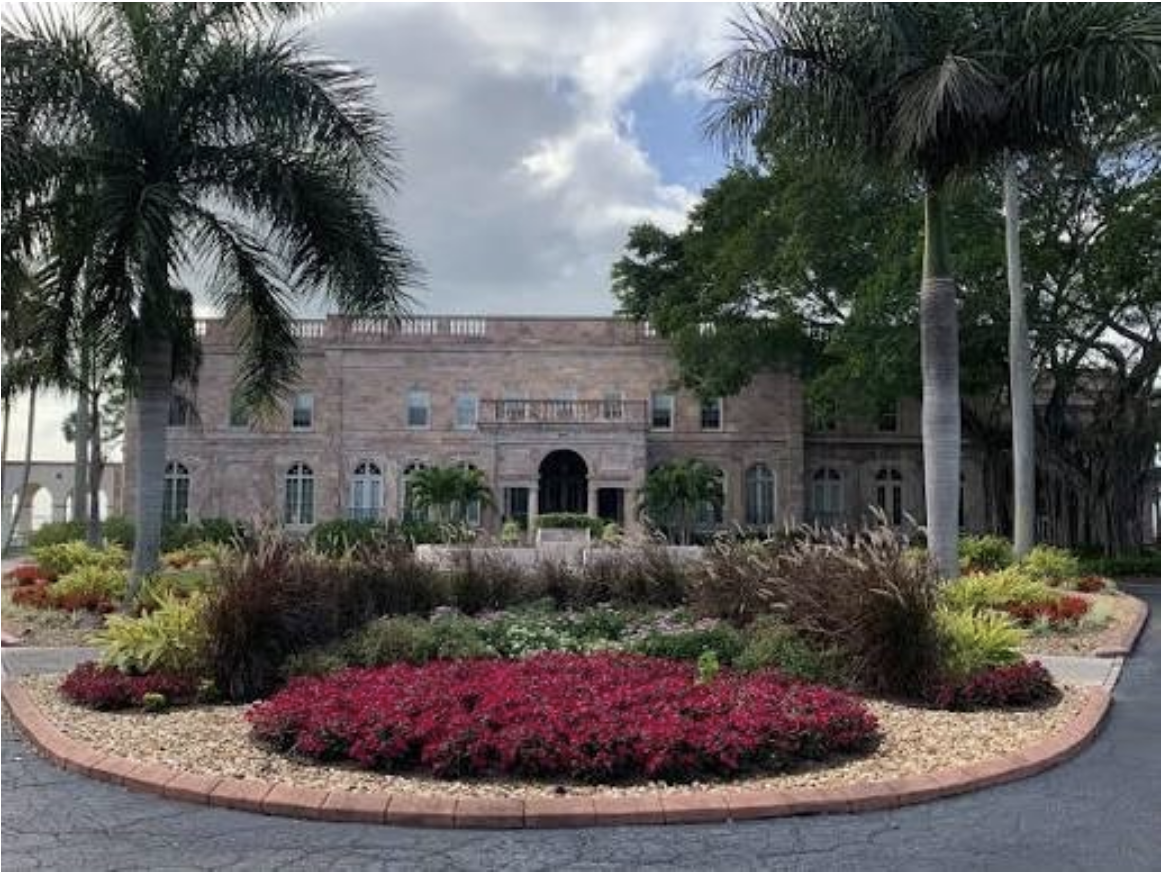
College Hall, New College of Florida, 2026. Note mostly exotic vegetation.
The following week Mr. Walsh cheered the school’s adoption of a cartoonishly steroidal representation of a non-native tree as its mascot. Never mind President Corcoran’s targeting of remnant native species and landscapes on its campus, from the mature live oaks cut down for a future baseball stadium to the Uplands Preserve across campus to the planned Freedom Institute to be built over now-wooded coastal habitat donated by Manatee County. All part of President Corcoran’s intent to make NCF “the number one most beautiful college and university” in the nation. His narrow-sighted landscaping vision is consistent with his bitter refusal as Florida’s house speaker in the mid-2010s to honor the overwhelming mandate of voters to restore conservation land-purchasing programs to pre-recession levels.

Mighty Banyan, on the gear?
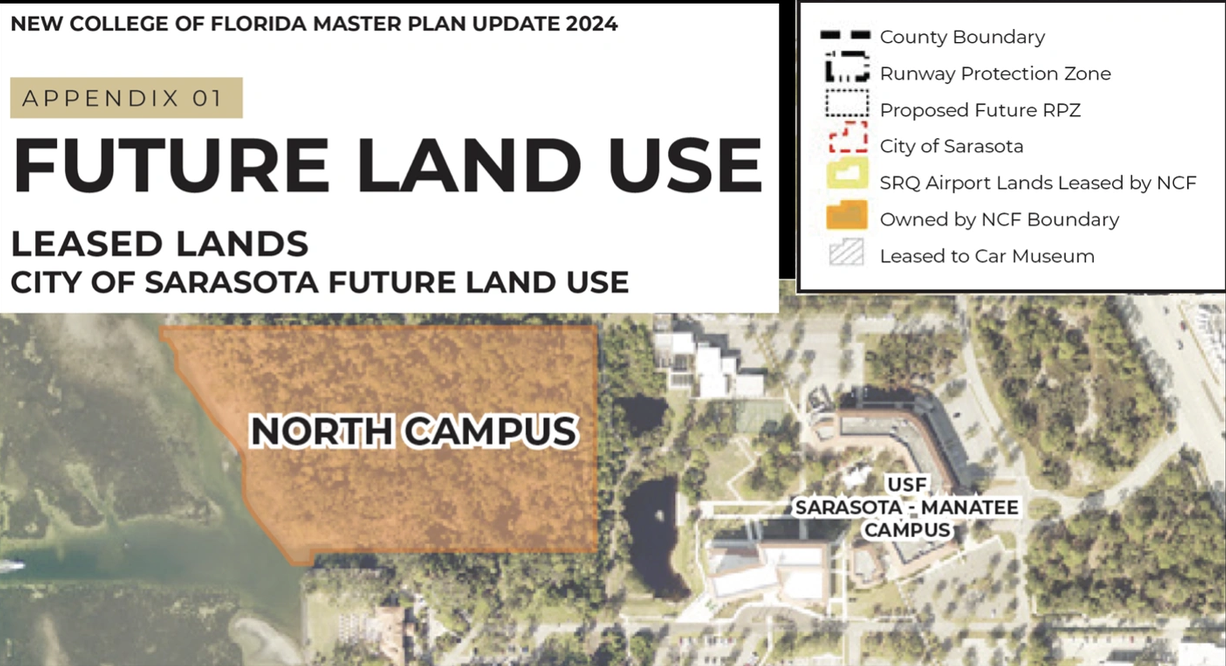
North Campus, now wooded, is site of future “Freedom Institute.”
Now we have the term-limited state senator Joe Gruters, who, as Andrew Warfield reported in [the Observer], “is a huge fan of royal poinciana trees.” These big bloomers are thought to originate in Madagascar, well outside District 22. Senator Gruters, in one of his final acts as the people’s representative in Tallahassee, told a group gathered to cheer the planting of these trees alongside many native species and some other exotics that “Over the last six years, I’ve been working on trying to bring color to Sarasota. I said I’m so sick of planting palm trees all the time. People said you can’t plant these royal poincianas because they’re nonnative.” He girded himself a couple years into his first term as senator to fight to have nonnative vegetation installed on the reconstructed interchange at I-75’s Exit 205: “I said we can do better.”
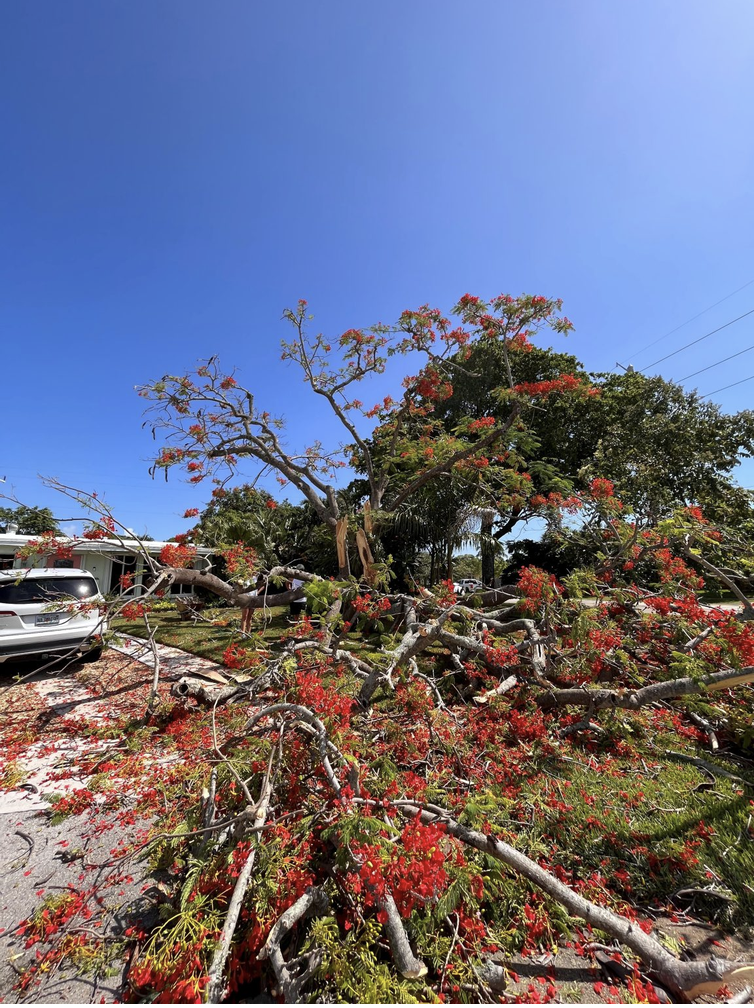
Royal Poinciana, fallen over
Between his culture war forays and climbing the inner-party ranks over those same years, his environmental victories seem limited to the 37 royal poincianas. He promises to see that other favorite nonnative species of his, jacaranda and tree of gold, are part of the landscaping when the under-construction Fruitville exit interchange is finished. He feels such species convey “our uniqueness and our ability to stand out.” “We’re bringing color to Sarasota.” While he’s been busy bringing color to Sarasota, he’s sat idly as funding for our flagship conservation land-acquisition program, Florida Forever, has been zeroed out.
Decades ago, Florida was unique in its early and active commitment to land conservation, with programs like the Land Acquisition Trust Fund that was established in 1964. Time and again, voters voted to tax themselves to conserve land and water.
What is it that makes a man see goodness in showy big-box plants and work tirelessly to eradicate life-giving and soul-satisfying native habitats? Our leaders today, enraptured with concrete and asphalt and bright flowers, have lost an equilibrium of moderation and the long-term dedication required for land conservation. But, then again, at least we stand out by drawing the attention of speeding drivers to bright flowers for a split second.
President Corcoran and Senator Gruters and Mr. Walsh are part of a lineage of people who felt that our native habitats, so green and brown, needed splashes of flash and pizzaz if not preferably annihilated wholesale. The water hyacinth, a South America native, is said to have been brought to Florida in 1884 or 1885 from the World’s Industrial and Cotton Exhibition in New Orleans by a Mrs. Fuller. She was excited to feature her souvenir as an ornamental on her property in Edgewater in northeast Florida. Like relativism in academia, it quickly grew out of control and Mrs. Fuller tossed excess plants into the St. Johns River. “Although rose gardening in Florida in the early 1900s proved challenging due to heat, humidity, sandy soils, and plant diseases,” according to the website of the Ringling Museum, Mable Ringling persevered, as Senator Gruters did for his beloved royal poinciana.
For at least the past century and a half, Florida has been a blank template for fantasies of a carefree tropical paradise, to the detriment of our native plants and other species that rely on them for food and shelter. Mrs. Fuller, with her passion for beautifying Florida in a particular way, would find botanical brothers in President Corcoran, Senator Gruters, and Mr. Walsh. The organisms that have been evolving in our region for far longer than the first Gruters showed up here are treated like pests, drab groupings of pines and palms violating motorists’ surface-level aesthetic preferences. (Look now: another billboard advertising cosmetic surgery.)

Look at me now!
Choices like this push Floridians further and further away from a sense of place. Having one is not some bizarre fad. It is the centerpiece of classical conservatism. Paul Kingsnorth, in Against the Machine (2025), describes “a tradition which takes its stand not according to ideological positioning, but according to actual positioning: on Earth, under the sky, surrounded by people who know where the sun rises in the morning, where they come from and who they are. It resists the Machine’s totalising force from a perspective rooted in the Four Ps: people, place, prayer, and the past.” To pick a bright exotic over a native frays the bonds to a place, cutting away living tissue to its past. There’s less and less of a here here, more of a globalized, cosmopolitan promiscuousness that ends up as a free-floating utopia for consumers that bulk growers, landscapers, developers, and politicians bet or assume the masses want it to be.
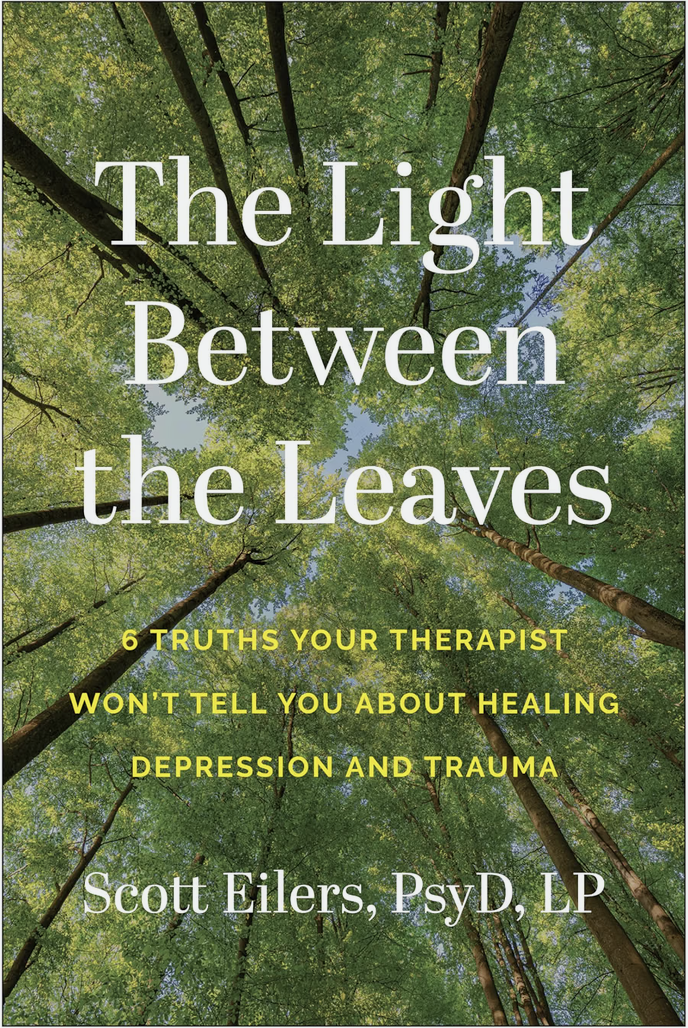
The clinical psychologist Scott Eilers is a rare psychotherapist who draws parallels between human nature and nature writ large. In The Light Between the Leaves (2026) he gives a lay description of nonnatives and their ills. On landscapes to which they don’t belong they are the law of unintended consequences incarnate. Eilers parallels invasive species with the introduction of, and later developing the power to resist, enticements—such as, for him, video games—that can throw off or destroy one’s “personal ecosystem.” “I didn’t grasp the scope of problems an invasive species like crown vetch can create,” Eilers writes. “They cause indirect harm by competing with native grasses. Every ecosystem has a vast, but ultimately finite, supply of resources. Every patch of soil and every ounce of rain is distributed among the inhabitants of the ecosystem. Anything that doesn’t belong there takes resources away from something that does. Every inch of space taken up by these flowers was an inch of space not taken up by a native grass or plant.”
Our human selves are not unlike natural systems. As it goes with nonnative plants and animals, like the Brazilian peppertree and Burmese pythons in Florida, that can create “ecological dead zones [that] can throw an entire region into a downward spiral and wipe out entire species due to a lack of resources,” so it goes with introducing harmful media, people, and thoughts, feelings, and behaviors into one’s life. “Just as there are rules for entering a national forest,” Eilers writes in an earlier section on boundaries, “there must also be rules for letting things and people enter your life if you wish to preserve everything natural and organic inside.”
It could be seen a small act, even something to be celebrated, but Gruters’ long push for nonnatives, to Mar-a-Lagoize a single interchange, should be seen in a larger context, the drip-drip-drip of creating a marketable product called “Florida” that robs all of us from understanding at a deep, elemental level of where we come from, where we live, and who we are. To undermine boundaries, like policies that encourage or mandate the planting of native species, is to rob citizens of such knowledge, on top of subtracting resources away from what belongs in a place. What was once wetlands and pine flatwoods and scrubby flatwoods and scrub rapidly gets rapidly and irrevocably remade into a laissez-faire whatever-whenever orgy of bright colors and twisty forms. The conservative approach, don’t move too fast and beware of unintended consequences, of right plant right place, gets torn apart like ancient saw palmettos giving way to another subdivision. FDOT’s policies for native planting, a product of compromise, gives way to power.
In the early 1980s, decades before President Corcoran moved here and as Gruters was a child and a few years before I was born, the interstate was being carved through the area, snaking southward to its terminus. A man named Tim Cash, I overheard from someone who knew him, planted stands of native trees along the roadway. You could say his planting was a celebration of what makes our community unique. I don’t know if his actions were authorized or not. I don’t know if it was more or less than six years that Mr. Cash spent planting trees along the newly expanded roadway. (A recent expansion to widen the lanes has seen many of the natives unceremoniously ripped out, cut up, and disposed.) But what Mr. Cash did was much more admirable than twisting the arms of FDOT bureaucrats to get a waiver for a few dozen nonnative trees to be planted. He planted trees that belong in this area, to create shade under which he would never sit. He died tragically young, in 1993 of AIDS before he turned 40, after founding Florida Scrub Growers nursery and helping found the local Florida Native Plant Society chapter. A sign at Old Miakka Preserve pays tribute to him.
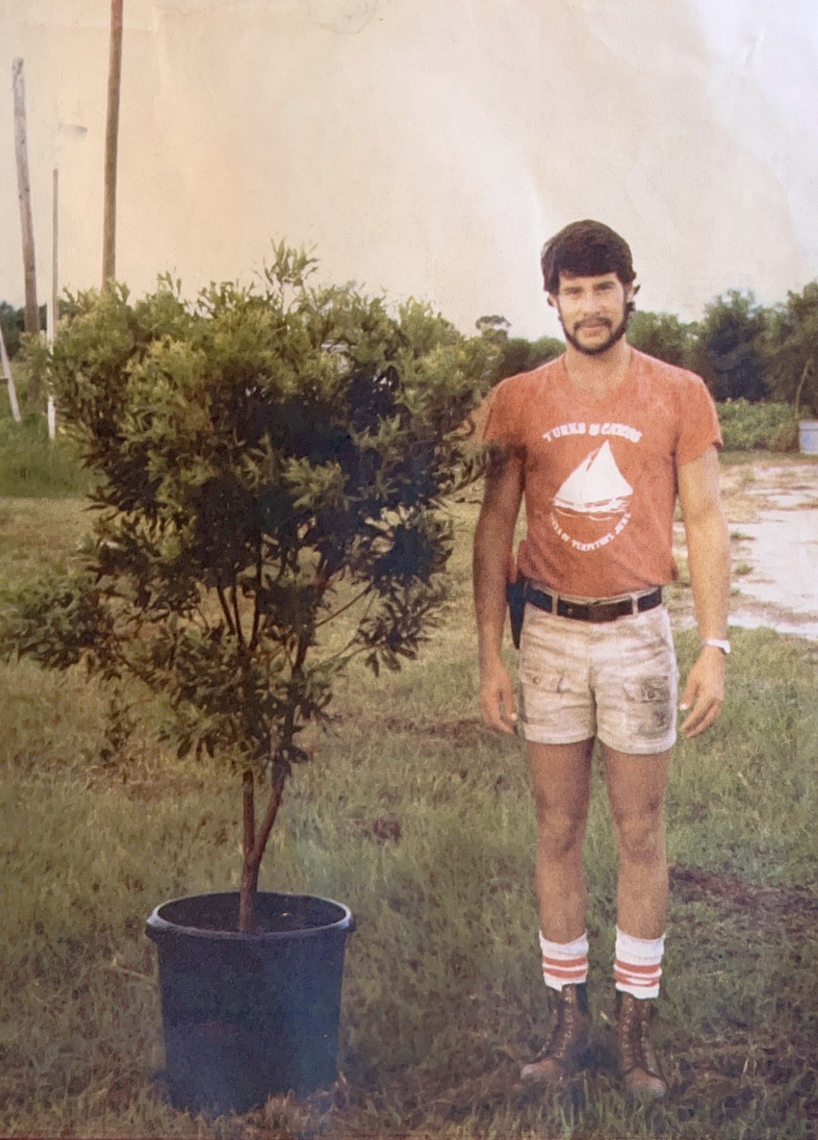
Tim Cash, 1954-1993
I don’t know what habitat type would have been where the Exit 205 interchange now is. Or maybe it was a transitional zone of different types, like the roadway itself now is in an artificial way. If it was pine flatwoods you’d see plant species like longleaf pine or south Florida slash pine, saw palmetto, gallberry, dwarf live oak, wiregrass, and others. Appreciating and understanding native landscapes can take more effort than it does to be wowed by the royal poinciana’s burst. It gives you the opportunity to cultivate the virtue of attentiveness. And if you are lucky and look closely you might even catch a glimpse of a rare, bright red pine lily (Lilium catesbaei), which has been adapting to the fires and floods that grace our landscapes for far longer than highways and cars have cut through them.
